Flying Private to The Open: Links Golf’s Moveable Airlift
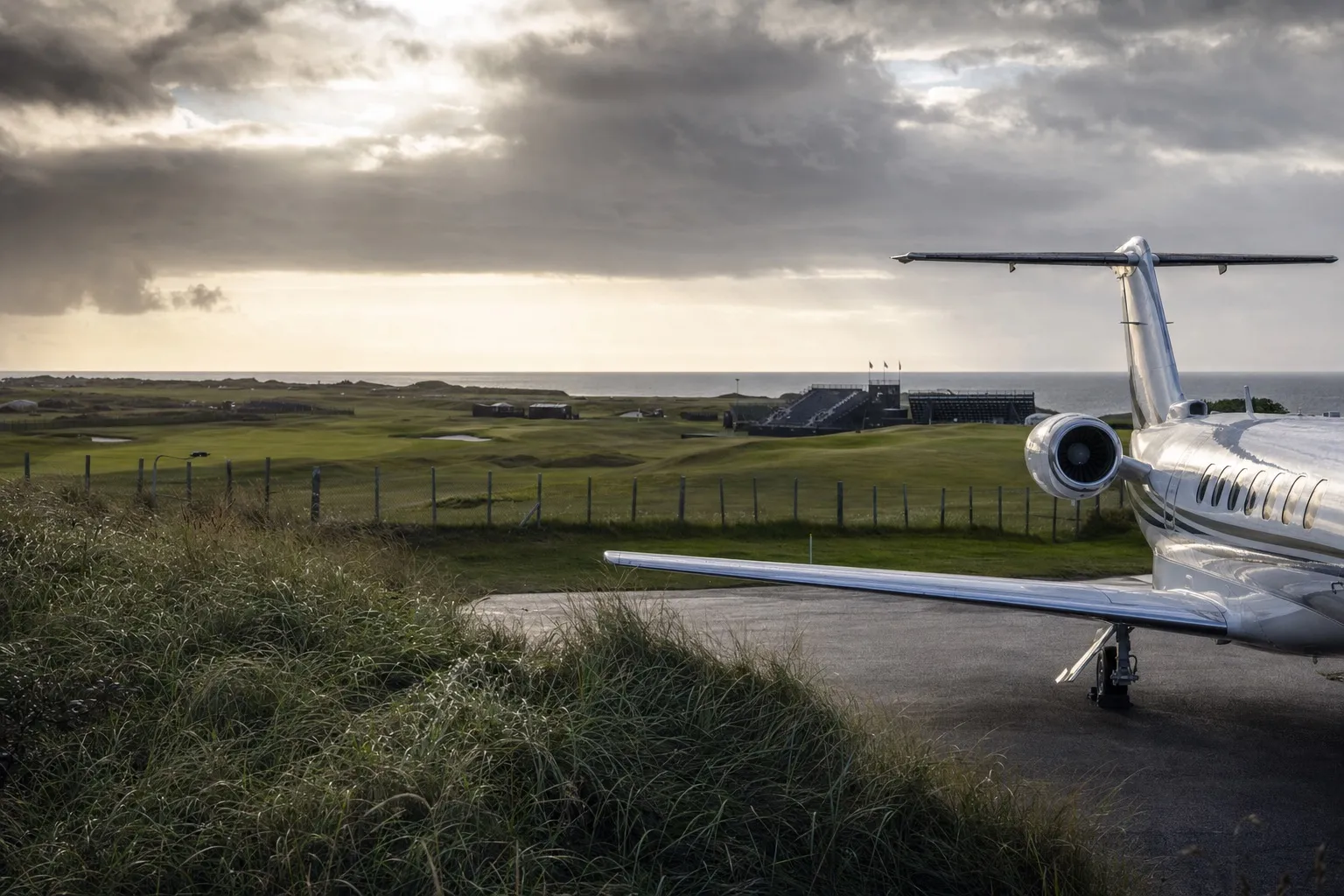
Most great sporting events stay put, and the aviation plan calcifies around them — everyone knows the Monaco drill, everyone knows the Silverstone drill. The Open Championship refuses to cooperate. It rotates around the coastal links of Britain and Ireland, which means that every July the charter market pulls out a map, finds a windswept seaside town, and works out — sometimes from scratch — how to deliver several hundred private flights to it.
That’s the fun of it. The Open is links golf’s moveable feast, and the airlift is a fresh puzzle each year.
The recurring shape of the puzzle
Wherever the Championship lands, the same pattern reasserts itself. Links courses sit on coastal duneland, usually near towns whose transport links peaked around 1935. There’s rarely a big airport next door — but there is almost always a small one, because the same flat coastal ground that makes links golf makes airfields.
So the plan is always three-tiered. A major airport within an hour or so takes the heavy metal and international arrivals. A small local airfield — often the entire reason the trip works — takes turboprops and light jets and puts you fifteen minutes from the gates. And a helicopter shuttle stitches together everything else, landing at a temporary site near the course.
This is turboprop territory, even more than Cheltenham. A King Air 350 or PC-12 into a 1,200-metre coastal strip beats a Gulfstream into a big airport an hour away, every single time. The short-runway argument wins The Open annually.
The Lancashire coast (Birkdale, Lytham, Hoylake across the Mersey) is the gentlest version: Liverpool takes everything, and the golfers’ choice, Blackpool, sits minutes from the northern courses. The Kent coast (Sandwich) leans on Lydd and Manston-area helicopters, with Biggin Hill an hour out. The Scottish venues — St Andrews, Troon, Turnberry, Muirfield — run through Dundee and Leuchars, Prestwick (jets to the door, for once), and Edinburgh respectively. Portrush brings the Irish Sea shuttle out in force, Belfast fields filling with traffic from Dublin and Britain alike.
The week itself
The Open runs Thursday to Sunday, with the pro-am crowd and hospitality wave arriving Tuesday and Wednesday. Inbound is comfortably spread. The crunch, as ever, is Sunday evening — final putt drops around 6pm, presentation, and then every aircraft on the coast wants to leave in the same ninety minutes, from airfields that handle this volume exactly one week per decade.
The veterans’ plays: fly home Monday morning (the R&A crowd’s standard move — the Sunday-night dinners near the course are half the event anyway); or watch the final round to the 15th hole and lift off before the rush, which sounds like sacrilege and feels like genius from 2,000 feet; or accept the queue with a drink in the FBO. What doesn’t work is landing a 6.30pm departure slot and expecting it to mean 6.30pm.
Day-tripping is very doable for the early rounds — Thursday and Friday day returns from London to the coast run £5,000–£9,000 on a turboprop or light jet, and split among a fourball or two, the arithmetic gets almost reasonable. Championship weekend carries the premium, along with hospitality-package helicopter seats, which sell out first.
Coastal weather, obviously
It’s links golf; wind is the point. The same gusts that make the leaderboard interesting make small coastal airfields sporty, and sea fog — haar, on the Scottish coasts — can shut a strip for a morning while the major airport an hour away operates normally. Build the same slack into your plans that the players build into their scores: morning arrivals, an hour of contingency, and a briefed fallback field. (How weather calls get made.)
The reward for solving all this is one of the best arrivals in sport: descending along a coastline, dunes and grandstands out one window, grey-green sea out the other, ten minutes from watching the best players alive argue with the wind. The Open makes you work out the route every year. It’s worth the homework.