The British Grand Prix by Private Aircraft: Silverstone’s Aviation Circus
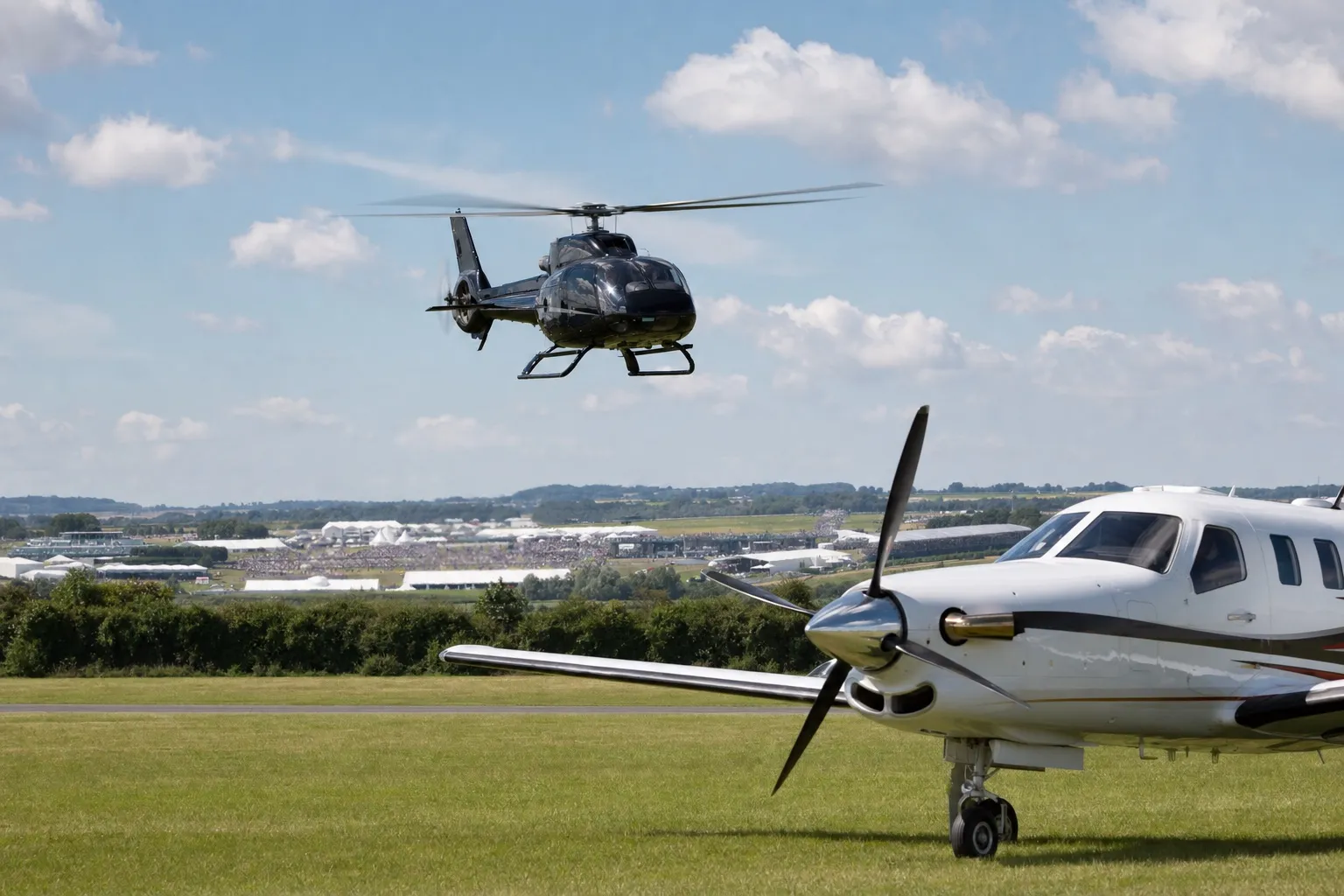
Silverstone on Grand Prix Sunday runs one of the busiest temporary heliports anywhere — hundreds of rotary movements in a day, machines landing and lifting every couple of minutes from morning until the post-race rush clears. For a patch of old RAF airfield on the Northamptonshire–Buckinghamshire border, it’s a remarkable piece of choreography, and it exists because of a simple, brutal fact: the roads don’t work.
A hundred and forty thousand people funnel into Silverstone on race day down what is essentially one dual carriageway and some B-roads. The traffic is legendary in the way Glastonbury mud is legendary. Which is why the British Grand Prix, more than any other UK event, is an aviation event — just not quite the kind people expect.
Jets land nearby, not at the race
Silverstone’s own strip handles helicopters and light aircraft on race weekend, not jets. The fixed-wing traffic spreads across a ring of airfields:
Turweston is the connoisseur’s choice — a small aerodrome ten minutes from the circuit that takes turboprops and light pistons. A King Air 200 or PC-12 into Turweston, car to the gate, and you’ve beaten everyone who flew something shinier into somewhere bigger.
Oxford (Kidlington) is the workhorse: proper business aviation facilities, takes light and midsize jets, about forty minutes from the circuit when the roads cooperate — which, on Sunday, they only partly do.
Cranfield and Coventry mop up the rest, and inbound international traffic tends to clear customs at Luton or Farnborough before hopping onwards or driving.
The genuinely time-rich combine them: jet into Oxford or Luton, helicopter for the last leg into the circuit’s heliport. On race day that final ten-minute hop saves upwards of two hours each way, which is why the helicopter shuttle operators sell out weeks in advance.
The turboprop’s big weekend
The British Grand Prix is the best advert going for the turboprop-over-jet argument. The fields closest to Silverstone have short runways and grass parking; a turboprop uses them and a jet doesn’t. Watching a King Air taxi in at Turweston while a Gulfstream’s passengers sit on the A43 is the event’s quiet annual comedy.
For domestic race-goers the maths is friendly too. Manchester or Edinburgh to Oxford in a turboprop, split six or eight ways, lands somewhere around the cost of decent hospitality tickets — and turns a five-hour Sunday-night drive home into forty-five airborne minutes. The north-to-south charter market exists for weekends exactly like this.
Timing, and the Sunday exodus
Inbound is civilised: arrivals spread across Friday and Saturday, and even Sunday morning flows. It’s the outbound that tests everyone. The race ends around 5pm and every helicopter, turboprop and jet within ten miles wants to leave at 5.30. Silverstone’s heliport clears its queue impressively fast, but “fast” still means waiting your turn while the champagne wears off.
The veterans’ tricks are the usual ones, locally adapted. Leave a deliberate two hours after the flag — the hospitality suites stay open, the queue evaporates. Or fly from the slightly further field: Oxford’s Sunday-evening departure queue is a fraction of the close-in chaos. Or stay Sunday night in Oxford and fly Monday morning, smug and rested.
Booking notes
Book helicopter shuttle seats and circuit landing slots as early as the flights — earlier, in fact, since heli capacity is the binding constraint. British GP weekend also collides with peak summer Med season, so aircraft that might otherwise sit around UK airfields waiting for you are off earning money in Ibiza; late bookers pay repositioning costs accordingly. Six weeks out is comfortable. Two weeks out is possible but pricier. Race week itself is beg-and-borrow territory.
And one very British footnote: it rains. Turweston and the grass fields can get soft, helicopters fly VFR, and a proper July downpour reshuffles everyone’s plans at short notice. Have your broker brief the wet-weather fallback — usually “Oxford and a car” — before the weekend, and check our weather guide for how those calls get made. The racing stops for nothing. The helicopters, occasionally, do.