Turboprop vs Light Jet: Why the ‘Slower’ Aircraft Often Wins
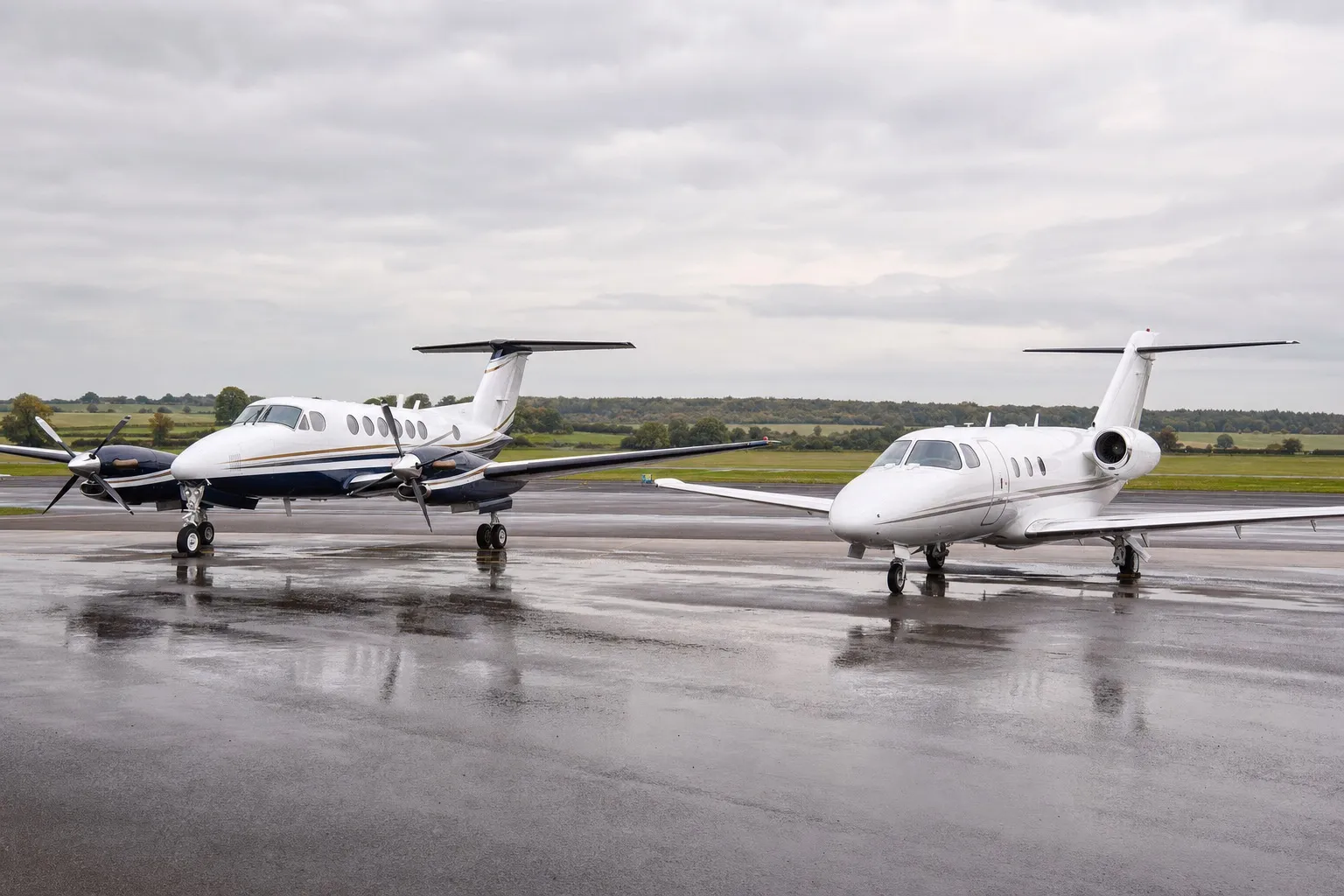
There’s a moment in a lot of charter conversations where we suggest a turboprop and the line goes quiet. You can hear the client thinking: propellers? Am I being fobbed off?
You are not being fobbed off. On a decent chunk of UK and short European routes, the turboprop is simply the better answer, and the industry does a poor job of explaining why. Let’s do the maths together.
The speed difference is smaller than it looks
A King Air 200 cruises at around 500 km/h. A Citation Mustang does about 630 km/h. That sounds like a big gap until you apply it to a real route.
London to Newquay is roughly 380 km. The jet saves you… about ten minutes of cruise. Once you add taxi, climb, and descent — which take the same time regardless of what’s spinning on the wing — the door-to-door difference on a route like London to Newquay is barely worth mentioning.
Stretch it to London–Geneva and the jet claws back maybe 20–25 minutes. Meaningful, but now hold that thought against the price difference.
The price difference is not small
For the same route and date, a turboprop typically comes in 30–45% below a light jet. On a London–Exeter or Newquay–Manchester run, that’s often the difference between £4,500 and £8,000. Per year, for someone flying a regional route regularly, propellers versus jets is a five-figure decision.
Why so much cheaper? Turboprops burn roughly half the fuel per hour, cost less to maintain, and — this is the underrated bit — can use shorter runways, which opens up smaller, cheaper airports.
The airport access thing is the real superpower
A PC-12 can land on about 800 metres of runway, grass included. A light jet generally wants 1,200–1,500 metres of tarmac. In practice this means the turboprop can get you to small regional strips and island airports that jets simply cannot use.
The classic example on our patch: the Isles of Scilly, where St Mary’s short runway makes fixed-wing turboprops (or the Skybus) the only game in town. But the same logic applies across France, the Alps foothills, and half the Scottish islands. Sometimes the “slower” aircraft is faster because it lands 5 km from your destination instead of 70.
What it’s actually like inside
Honest answer: a modern King Air 350 or PC-12 interior is club seating, leather, tables — visually indistinguishable from a light jet to most passengers. The Piaggio Avanti has a taller, wider cabin than most light jets, which surprises everyone who boards one.
The differences you’ll actually notice:
- Noise. Props are a bit louder and more of a drone. Modern cabins are well insulated; it’s more “background hum” than “wartime newsreel.” Headphones solve it entirely.
- Altitude and weather. Jets cruise higher (41,000ft vs ~30,000ft), which means smoother air more of the time. On a bumpy day, the jet has more options to climb above it.
- The look. Some passengers just want to arrive in a jet. This is a legitimate preference and nobody at the FBO will say a word either way.
When the jet is genuinely the right call
Two clear cases:
- Anything over about 90 minutes of flying. The speed gap compounds, cabin altitude comfort matters more, and by London–Ibiza distances the jet earns its premium.
- Schedule-critical days with bad weather forecast. The jet’s ability to climb over weather and its speed margin give crews more ways to keep you on time.
And one soft case: client-facing trips where the optics matter to you. Know thyself.
The rule of thumb we actually use
Under an hour of flight time: turboprop, almost without exception, and pocket the difference. Sixty to ninety minutes: whichever is cheaper or better positioned that day. Over ninety: jet.
If a broker never mentions turboprops for your Exeter run, ask why. The good ones bring it up before you do.