Fog, Snow and Acts of God: What Actually Happens When Your Private Jet Can’t Fly
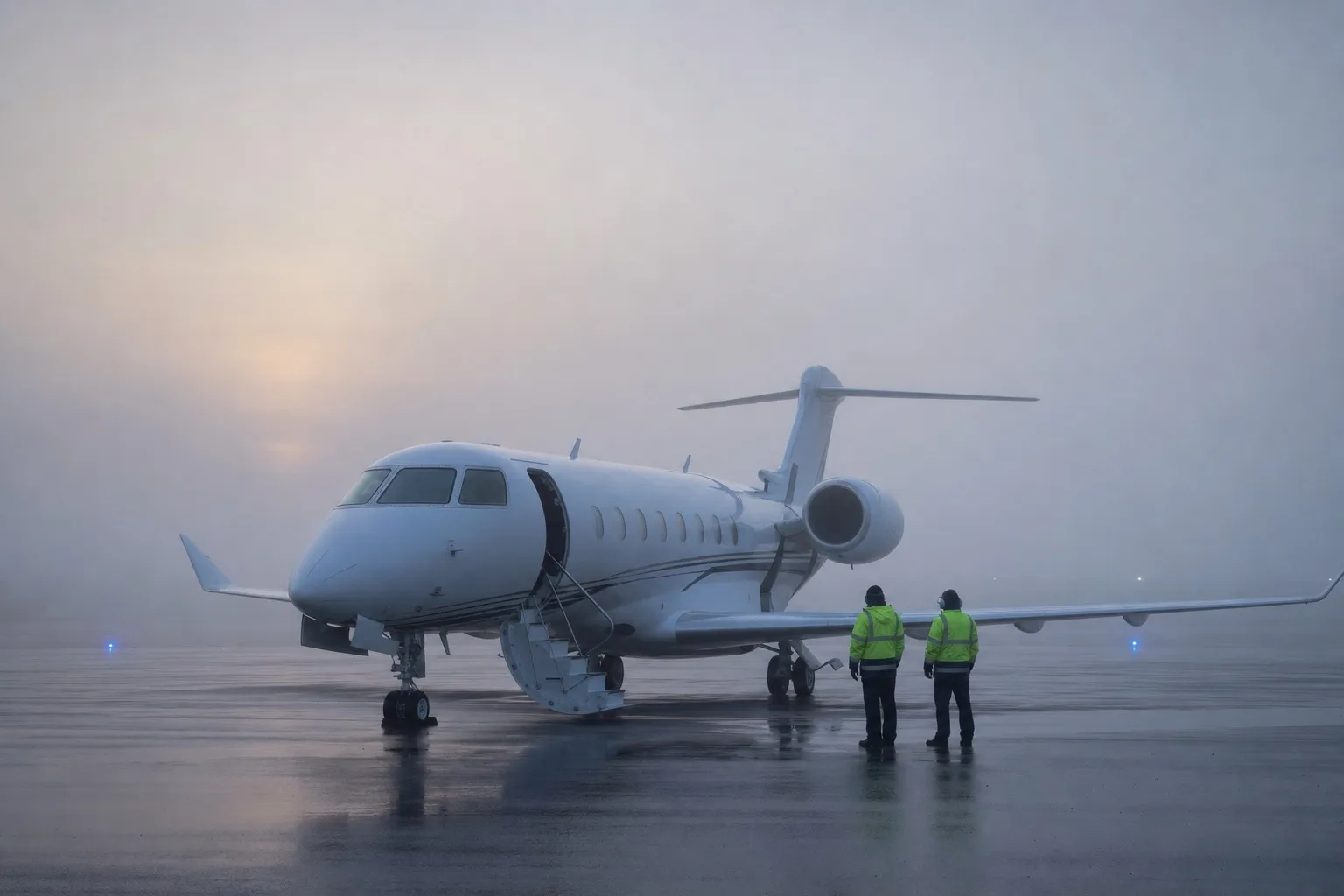
A persistent belief among first-time charterers: the jet always goes. You’ve paid all that money; surely weather is a problem for other people.
Afraid not. Your chartered Citation sits on the same fog-bound airfield as the Ryanair fleet, and the laws of physics are not impressed by the catering. What is different — completely different — is what happens next. The airline passenger’s delay is an announcement and a queue. Yours is a phone call and a set of options.
The most common scenario: the quiet reroute
Most weather “cancellations” in private aviation aren’t cancellations at all. They’re reroutes you barely notice.
Fog closes Cannes? You land at Nice, 25 minutes up the coast, where the car simply meets you at a different FBO. Snow shuts Chambéry? Geneva or Lyon, and the transfer is longer but the holiday intact. A light jet can use hundreds of European airfields, and your operator’s dispatch desk has been watching the forecast since yesterday. Very often the first you hear of a weather problem is a message the evening before: “Cannes looking foggy until mid-morning — suggest we plan Nice instead, cars rebooked, same departure time.”
This is the single biggest practical difference from commercial flying. An airline can’t send its A320 wherever the weather is better, because 180 passengers booked Cannes. You can. The destination is a preference, not a contract with a timetable.
The second most common: the wait
Sometimes the right answer is simply to leave two hours later and let the fog burn off. Here the private terminal earns its keep. Waiting at an FBO means armchairs, coffee, working Wi-Fi and your crew walking over in person to say “looking like an 11:15 departure.” Waiting is never fun. Waiting with a named human who knows your situation and answers questions is a different sport from waiting under a departures board that says DELAYED in orange.
And because the aircraft is yours for the day, a delayed departure doesn’t cascade into a missed connection. The whole itinerary just slides.
De-icing, snow, and winter honesty
Winter deserves its own paragraph because it produces the most invoices people don’t expect. De-icing is charged at cost and it isn’t cheap — several hundred to a couple of thousand pounds depending on aircraft size and how much of Sweden’s glycol supply your wings need. It’s also completely non-optional, for reasons any pilot will explain with feeling.
Snow closures at Alpine airports are a fact of ski season — it’s snow, at a ski resort, that’s the product working as intended. The regulars’ tricks for riding it out are in our Alps survival guide, but the headline is: build one flexible hour into transfer days and you’ll be fine nine seasons out of ten.
When the flight genuinely can’t happen
Occasionally weather wins outright — the storm that shuts half of Europe, the volcanic ash summer, the freeze that closes everything from Manchester to Munich. Then it comes down to the contract, so here’s the plain-English version of how most charter agreements treat it:
Weather is nobody’s fault. If the flight is impossible and can’t be reasonably rescheduled, the standard position is a refund of the charter price, sometimes minus costs already irrecoverably spent (handling fees, catering already loaded). What you generally don’t get is compensation for consequences — the hotel night, the missed event. The airline rules (EU261 and friends) that pay commercial passengers fixed sums don’t apply to private charter.
Rescheduling usually beats refunding. Operators would far rather move your flight than unwind it, and they’ll typically do so without drama. Tell your broker what actually matters — “we must be there by Friday 2pm” — and let them solve for that, rather than fixating on the original departure time.
Read the cancellation clause before you sign, not after. Every reputable booking process includes a contract with the weather and force majeure terms spelled out. Sixty seconds of reading, once, and you’ll never be surprised.
How the pros protect themselves
Frequent flyers do three things almost unconsciously. They keep plans flexible at the destination end — nothing immovable within a few hours of landing on a winter or fog-season trip. They pick aircraft with margin: better-equipped jets have lower approach minima, and a competent crew on a well-kitted aircraft lands in weather that turns a lesser combination away. And they tell their broker about the constraint that really matters, so every plan B gets built around it.
The honest summary: private aviation doesn’t beat the weather, it out-manoeuvres it. You’ll be delayed occasionally, rerouted now and then, and genuinely stranded almost never — because there’s nearly always another airfield, another hour, another way to skin the trip. The fog is the same for everyone. Having options in the fog is what you’re paying for.